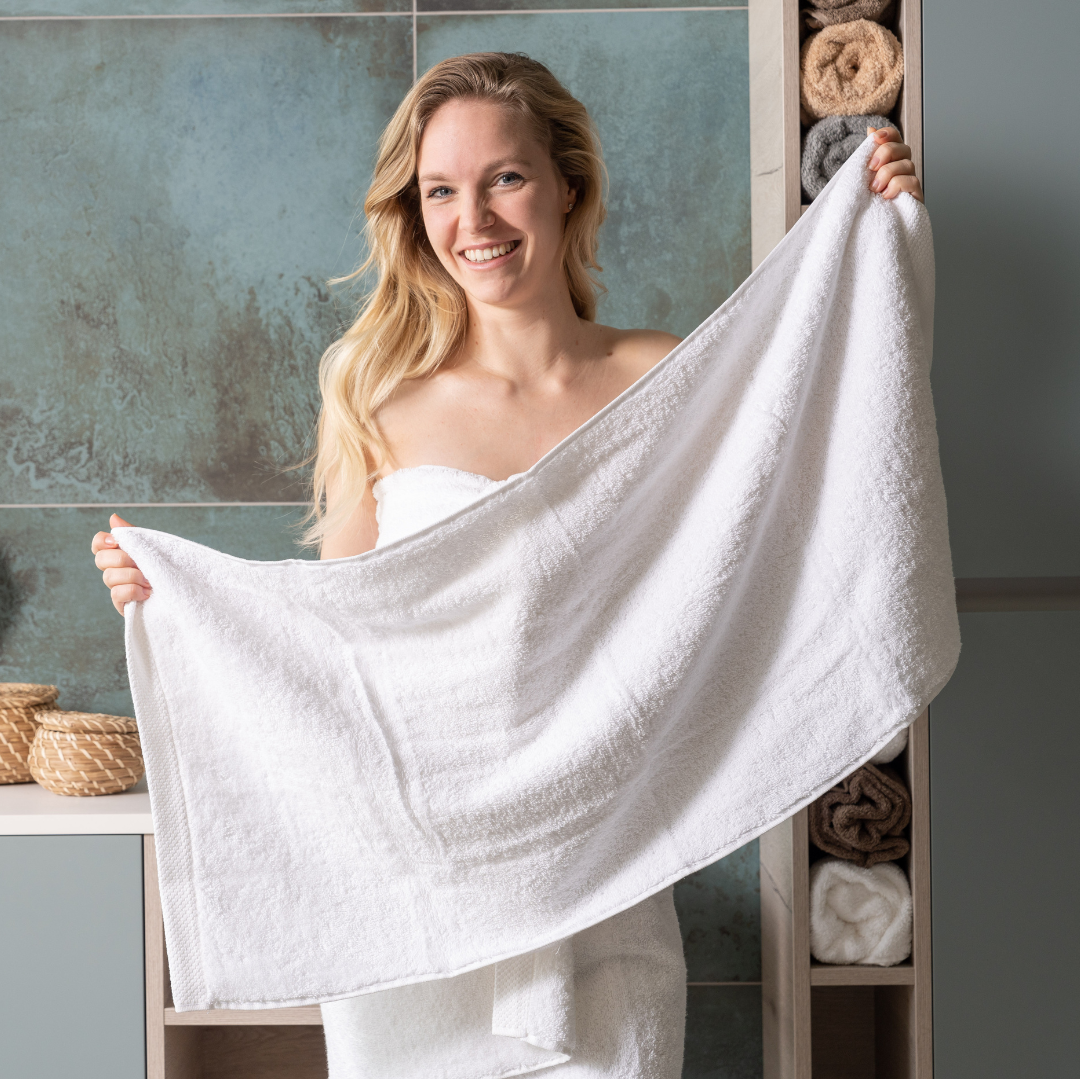
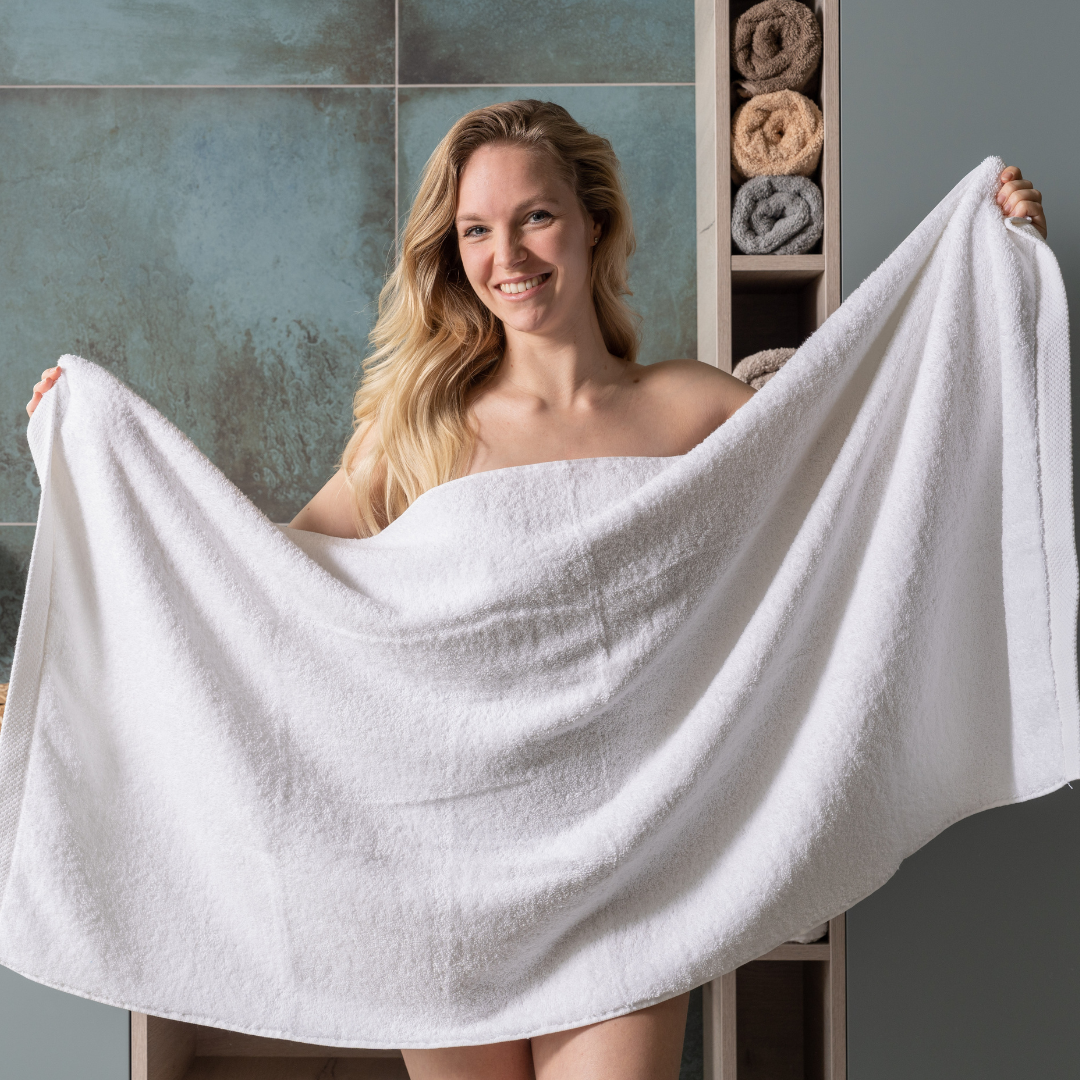
You step out of a wonderfully warm shower, grab your soft towel and start drying yourself. But no matter how many times you wipe your skin, it still feels slightly damp. It's almost as if your towel is simply moving the water around instead of absorbing it.
Sound familiar? It can be incredibly frustrating, especially when you've invested in towels that are supposed to feel soft and luxurious.
A towel can feel incredibly soft without actually absorbing water very well.
How is that possible? At Miss Towels, we'll explain what really makes a towel absorbent, why some towels don't dry your skin effectively and what you can do to improve their absorbency.
Why isn't my towel absorbing water?
A good towel needs two important qualities: it should absorb water quickly and be able to hold a sufficient amount of moisture.
These might sound like the same thing, but there's an important difference.
For example, a towel can hold a lot of water when it's completely wet, yet still absorb moisture from your skin relatively slowly.
How effectively a towel dries your skin depends on several factors, including the material, yarn structure, terry loops and the way the fabric has been finished.
Proper care also plays an important role.
That's why even a towel made from 100% cotton can become less effective at drying your skin over time.
5 reasons why your towel isn't absorbing water properly
1. There's too much fabric softener in your towel
This is one of the first things we'd recommend checking.
Fabric softener is designed to make textiles feel softer. It does this using substances that can attach themselves to cotton fibres.
That might sound appealing, but some of these substances can reduce how easily the fabric absorbs water.
The result? Your towel feels wonderfully soft but doesn't absorb moisture as effectively.
Our tip: Try washing your towels a few times without fabric softener. Use a suitable detergent and follow the recommended dosage.
2. Your towel still contains residues from manufacturing
Have you recently bought new towels and noticed that they don't absorb water as well as expected?
The finishing process during manufacturing may be a contributing factor.
Various treatments are used during towel production. Certain finishing agents can influence how easily water penetrates cotton fibres.
As a result, a new towel may perform differently after its first few washes compared with how it behaves straight out of the packaging.
Our tip: Always wash new towels according to their care labels before using them for the first time.
This can help remove loose manufacturing residues and certain remaining finishing agents.
3. Detergent residues are left behind
Using too much detergent can also cause problems.
If your washing machine doesn't rinse the detergent away thoroughly, residues may remain trapped in the fabric.
This can affect how the towel feels and performs.
So don't automatically add extra detergent just because your towels are thick.
Our tip: Follow the detergent manufacturer's dosage instructions and consider your water hardness. Also make sure there's enough room in the washing machine for your towels to be rinsed thoroughly.
4. The towel's structure is less effective at absorbing water
Have you ever wondered why a terry towel can dry your skin so much more effectively than an ordinary piece of cotton fabric?
One reason is the thousands of small loops in the fabric.
These terry loops increase the surface area that comes into contact with water. They also create tiny spaces between the fibres and yarns where water can move and be held.
But not every terry construction is the same.
The length, density and structure of the loops can all influence absorbency.
That's why two towels with exactly the same fabric weight can still absorb water very differently.
5. Your towel is worn out or heavily soiled
Towels can change after extended use.
Washing, friction and everyday use can gradually wear down cotton fibres. Body oils, dirt and detergent residues can also build up if the fabric isn't cleaned thoroughly.
As a result, a towel may start to feel different and become less comfortable to use.
Check whether your towel still has a full terry-loop structure and whether it feels genuinely clean after washing.
If the towel is heavily worn and continues to absorb water poorly despite proper care, it may be time to replace it.
How to make your towels more absorbent again
Fortunately, you don't need to throw away a towel just because it isn't absorbing water properly.
Try these steps first:
- Stop using fabric softener for now. This prevents you from adding more softening substances that may affect water absorption.
- Wash your towels according to their care labels. Choose a suitable washing programme and an effective detergent.
- Use the correct amount of detergent. More isn't automatically better.
- Don't overload your washing machine. Towels need enough space to move and rinse properly.
- Allow your towels to dry completely. You can use a suitable tumble-drying programme if the care label allows it.
Do you notice an improvement after a few washes? Then your previous washing routine may have contributed to the problem.
If the issue continues, the cause may lie in the towel's construction or finishing rather than the way you care for it.
Are thicker towels always more absorbent?
Many people assume that a thicker towel automatically dries their skin more effectively.
It sounds logical. After all, more cotton means a towel can potentially hold more water.
However, there's an important difference between how much water a towel can absorb and how quickly it absorbs that water.
Let's compare an 800 GSM towel with a 550 GSM towel.
An 800 GSM towel contains more textile material per square metre and may hold more moisture when the materials and construction are otherwise comparable.
But that doesn't automatically mean it absorbs water from your skin more quickly.
The yarn structure, terry loops and fabric finishing also play an important role.
Additionally, an extra-heavy towel may take longer to dry completely after use.
So the best choice depends on your personal preferences.
Do you love exceptionally thick, heavy and substantial towels? Then 800 GSM might appeal to you.
Are you looking for a comfortable combination of a luxurious feel and a manageable weight for everyday use? Then 550 GSM is also an excellent option to consider.
Why do we choose 550 GSM and combed cotton at Miss Towels?
At Miss Towels, we believe a luxurious towel shouldn't just feel wonderfully soft.
Above all, it should dry your skin comfortably and effectively.
That's why our towels are made from 100% cotton with long, combed cotton fibres. They have a fabric weight of 550 GSM and are carefully finished with double-stitched side seams.
Combing cotton helps remove some of the shorter fibres and align the remaining fibres more evenly. This can contribute to a more consistent yarn structure.
With 550 GSM, we've chosen a full, comfortable towel that remains practical and easy to handle.
But we also believe in being transparent: these specifications alone don't prove how quickly a towel absorbs water. Its overall construction and finishing also matter.
Our aim is to create a towel that brings together softness, absorbency and everyday comfort.
Because after a warm shower, the last thing you want is to keep rubbing your skin just to get dry.
You want to wrap yourself in a comfortable towel and enjoy that wonderful feeling you recognise from a luxury hotel.
Right at home, every single day.
When should you replace a towel?
A towel that doesn't absorb water properly doesn't necessarily need replacing straight away.
First, see whether changing your washing routine makes a difference.
However, if a towel barely absorbs moisture despite proper care, shows visible signs of wear or no longer feels comfortable, replacing it may be the best option.
Have you purchased towels from Miss Towels and noticed they aren't drying your skin as expected? Feel free to contact us. We're always happy to help.
Conclusion: softness is wonderful, but absorbency matters just as much
A soft towel feels amazing. But ultimately, you want it to do what you bought it for: dry your skin comfortably.
Poor absorbency can have several causes, including fabric softener, manufacturing residues, detergent build-up or the towel's structure.
With the right care, you may be able to improve how effectively your towel absorbs moisture.
And if you're ready to invest in new towels? Look beyond thickness and softness alone.
Discover the 550 GSM towels from Miss Towels and experience the luxury hotel feeling in your own home.
Frequently asked questions about towels that don't absorb water
Why don't new towels absorb water properly?
Some new towels may contain remaining finishing agents that influence water absorption. Washing them according to the care label before their first use may help.
Does washing without fabric softener help?
It can. Some fabric softeners contain substances that affect how easily towels absorb water. Leaving fabric softener out of your washing routine is therefore a sensible first step.
Is 800 GSM more absorbent than 550 GSM?
A heavier towel may hold more water when its construction is otherwise comparable, but it doesn't automatically absorb moisture more quickly. GSM alone doesn't determine how effectively a towel dries your skin.
Why does my towel get wet but fail to dry my skin properly?
This can happen when water penetrates the fabric relatively slowly. The yarn structure, terry loops and any finishing agents may all play a role.
Can I restore the absorbency of a towel?
Sometimes. If fabric softener or built-up residues are partly responsible, adjusting your washing routine may help. However, if the problem comes from the towel's construction, washing alone won't completely solve it.